
T: 01822 851370 E: [email protected]
Visit RSN Survey about life in rural England to find out more.
RSN Voices Serious Concerns Over ‘Fairness’ Of Settlement

The Rural Services Network has serious concerns over the new ‘fair and transparent’ Local Government Funding formula.
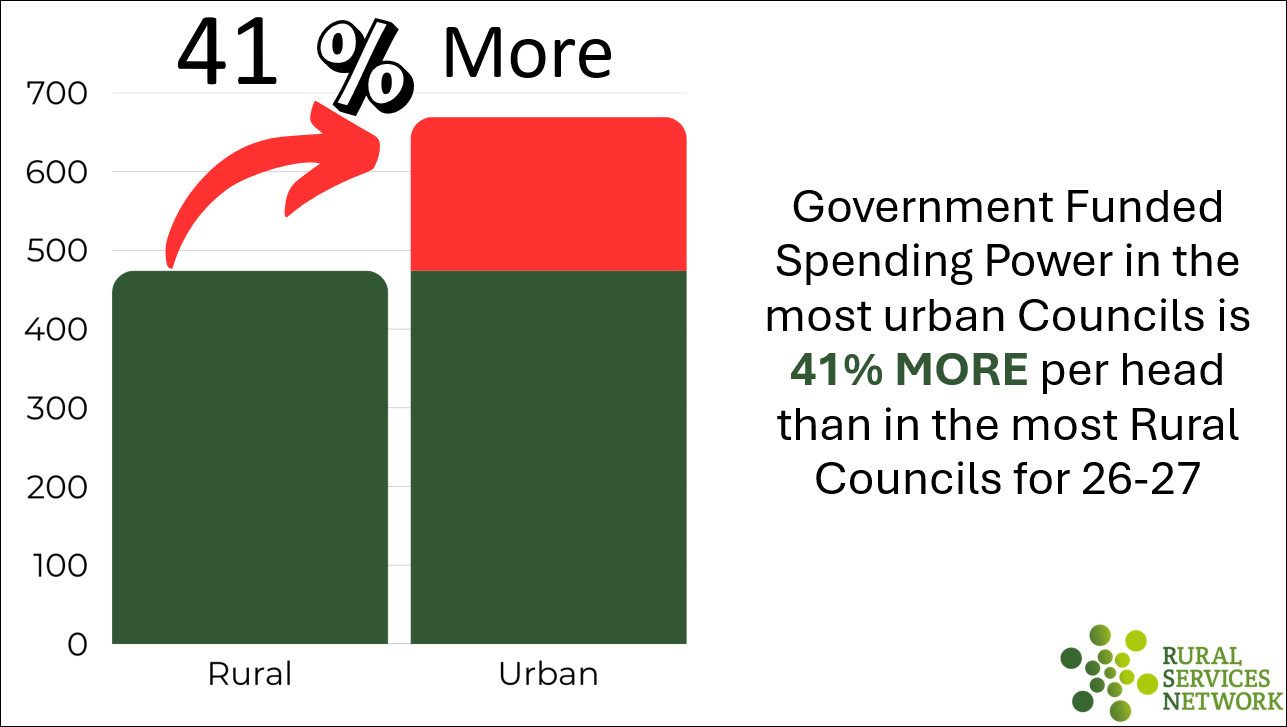
- Our analysis shows that in 2026-2027, the most urban councils will receive 41% more in Government funded spending power per head, than the most rural councils.
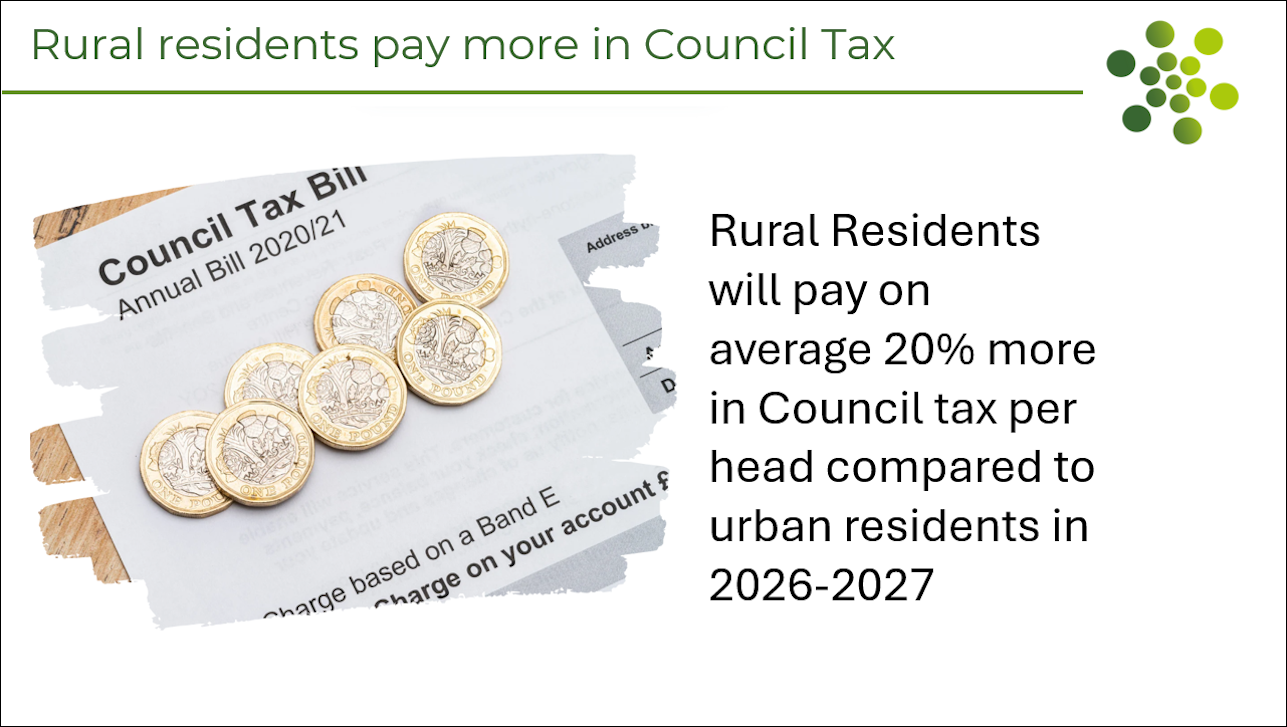
- Rural residents will pay on average 20% more than urban residents for their council tax.
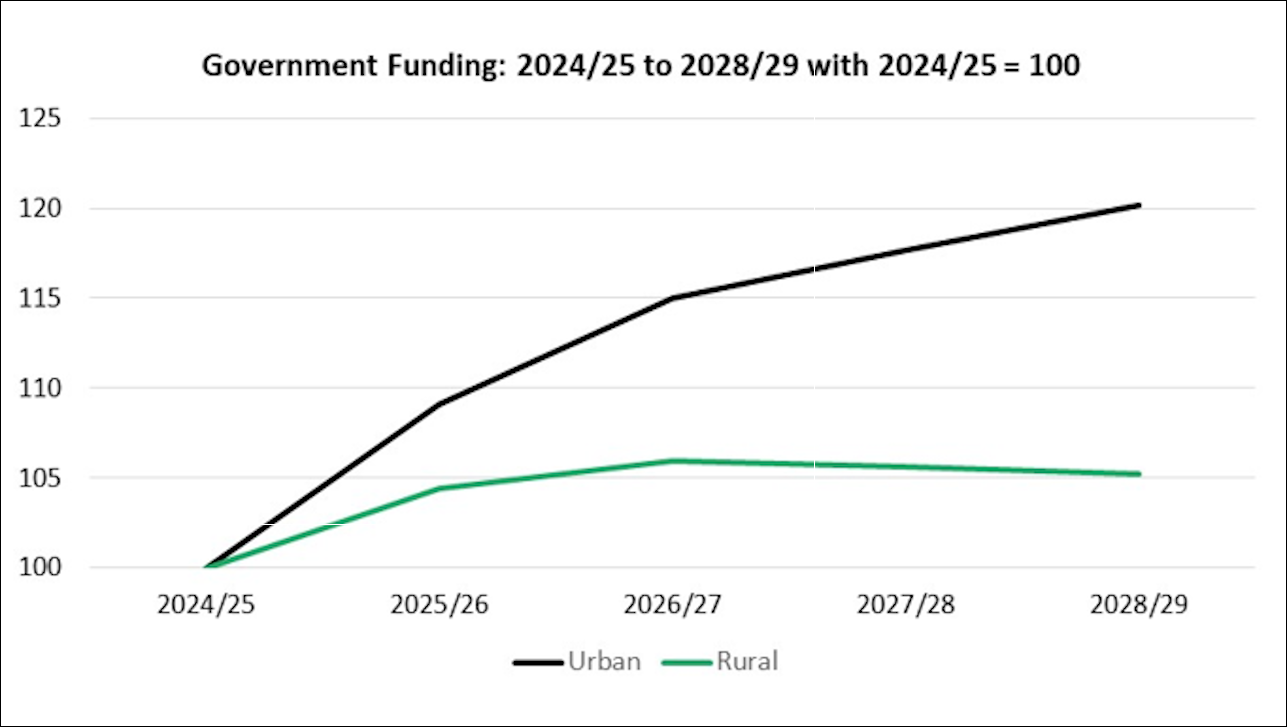
- When mapped over a 5 year period, the Government Funded Spending Power for the most urban councils, increases by 21%, compared to the most rural where it almost flatlines at 1%.
 |
 |
 |
The Rural Services Network will be responding to the consultation which closes tomorrow (14th January), and our response will highlight some of the following key points:
Burden Of Funding Public Services Will Fall On Rural Working People
The proportion of Core Spending Power that is funded by Council Tax is hugely concerning. Core Spending Power includes Government Funding and the income raised by Council tax, nearly 75% of the increase in Core Spending Power is funded by assumed increases in council tax. The burden of funding public services will fall on rural residents.
Old Data Is Used At The Same Time As New?
The Government announced that this formula would bring in a ‘Fair and evidence-based funding system’. However, whilst the formula itself, uses Index of Multiple Deprivation (IMD) 2025 figures as being the most up to date and relevant figures to use, the Government has also decided to continue the Recovery Grant (despite it being introduced in the current year as a one-off grant) and implement a separate transitional system based on it, which is without technical foundation and contrary to the principles set out by Ministers last December. The basis of the grant has not been updated and continues to use the 2019 IMD. Therefore both outdated 2019 and the new 2025 IMD data is used in the settlement, this is not a fair and evidence based system.
Almost No Consideration For Additional Cost Of Delivering Services To Rural Communities
The settlement has removed ‘remoteness’ uplift from the Area Cost Adjustment (ACA) in all of the Relative Needs Formulas except Adult Social Care. The technical case was very strong for the inclusion of remoteness. MHCLG has undertaken statistical analysis in previous settlements and drew the conclusion that remoteness was statistically significant and should be included in future funding formulas. It said that there is a “compelling theoretical case for including this adjustment.”
The RSN is concerned that there is now no remoteness uplift in any of the other Relative Needs Formulas, which ignores the additional costs faced by rural councils in the delivery of services to sparsely populated areas. Notwithstanding additional travel time to deliver services, there are other considerations such as the implications of serving a sparsely populated area, smaller 4x4 refuse collection vehicles have to return to base to empty more often than larger vehicles, more service centres are required to ensure that residents can access services, which won’t provide the same value for money as those serving large populations, when contracts are put out to tender, councils can receive very few responses, often only from the incumbent provider, leading to a market without competition and increasing prices.
None of these are considered in the new formula apart from in Adult Social Care leaving the additional cost of delivering services to sparsely populated areas ignored.
Is Deprivation Only Driver Of Additional Cost?
There has been no evidence published by the government to demonstrate that deprivation is the key factor for distributing funding to local government. Indeed, the research undertaken by MHCLG in 2018 suggested that deprivation “was not a major cost driver for the services included in the Foundation Formula”.
The same research found that population was overwhelmingly the most important factor, driving 88% of the variation of upper-tier costs in the Foundation Formula, and 84% of the lower-tier costs. MHCLG has not published any evidence that would lead it to change its conclusions about the relative importance of deprivation for distributing general funding to local government.
This leads to the conclusion that there is no such evidence and that the decisions are certainly not evidence based.
Short Consultation Period
The consultation period, for a subject that impacts the financial viability of local authorities and residents across the country is extremely short, just 17 working days.
That doesn’t include for the fact that it takes in the Christmas holiday period when many councils and MP offices shut down completely, reducing that 17 days even further.
It is difficult to consider it an effective consultation considering the lack of time for key stakeholders to respond adequately.
 |
Kerry Booth, Chief Executive Of The RSN Says:
|
The consultation can be accessed at this link: https://www.gov.uk/government/consultations/provisional-local-government-finance-settlement-2026-to-2027/provisional-local-government-finance-settlement-2026-to-2027


